
The Reciprocity Gap
On friendship, partnership, and what we sacrifice when we close the door on vulnerability

I’m scooping up hummus in big globs, perched at my friend’s countertop.
She stands across from me, holding up a spatula in her right hand as she thinks. We used to live together as peaceful acquaintances. Niceties in the kitchen. A shared pot of coffee — that sort of thing.
Then COVID hit, and we found ourselves in a bubble of intimacy. I was reeling from heartbreak, she was in a new relationship, and she quickly became my life partner. We did everything together. There was an almost instantaneous sense of ease and comfort.
She’s that rare blend of solid and light-hearted. Sincere, but never takes herself too seriously. Inquisitive, hilarious, and highly attuned to others. And despite the overwhelming uncertainty of the times, our newfound friendship bubble-wrapped my grief with safety. We’ve been close ever since. I imagine our friendship will be forever stained with those never-ending days together. Thank goodness for that.
Another close friend comes bounding in the door. She’s vivacious and indescribable. Every person that I’ve ever introduced her to is enamored. And not just because she’s hilarious. Or kind. Or an amazing conversationalist. But because she’s refreshing. She puts people at ease. She is hilarious, but in a way that feels caring. She is one of the most intuitive people I’ve ever met, and I don’t even think she knows it.
We met at work, bonded by the cliché tech start-up culture that we oscillated between resenting and worshipping. Her heart broke first, then mine. And because of that, our work was laced with friendship. Thank goodness for that. I tapped her arm every so often to look at an email draft (she’s a true wordsmith) or caught her eye when my grief threatened to spill out during a meeting (in the form of ugly tears).
The erosion of vulnerability
When I think of my 20’s, I see these two women. Between them, they used to know basically every detail of my life. Now, we stand in the kitchen catching each other up. Veering this way and that, trying to understand the shape of a life that we once knew so well.
And it’s not that age has carried us away from each other, necessarily. To some degree, it’s normal. For one, we don’t share a living space. We don’t work together. I live in a different city, reducing our visits to 2-4x per year. So there’s a proximity piece here — that type of intimacy requires togetherness.
But it’s also something else. Something a little more subterranean. Something we dug up, as we sat on the living room floor, pausing between bites to listen to one another.
When we get into long-term relationships, the proverbial iron gate comes down. We close the blinds. Sometimes we even shutter the windows. We avoid talking about our relationships the way we used to. Rarely, if ever, do we disclose the recurring fight, the values-misalignment, friction with in-laws, or just the seasonal nature of romantic connection. And when we stop talking about what matters, we lose what’s real.
We don’t want our friends to know, because we don’t want them to judge. To jump to conclusions without the context. To make broad, sweeping statements about the state of our relationship without any of the nuance. To write off our partners or silently judge our actions. And because our long-term partnerships feel more permanent, they feel more fragile. We’re protective of them in a way we never were in our twenties.
And it’s all fair, but what happens to our friendships when we stop talking about what’s real? And what’s the cost to our relationship when we slam the door on the support and perspective from friends that we once needed?
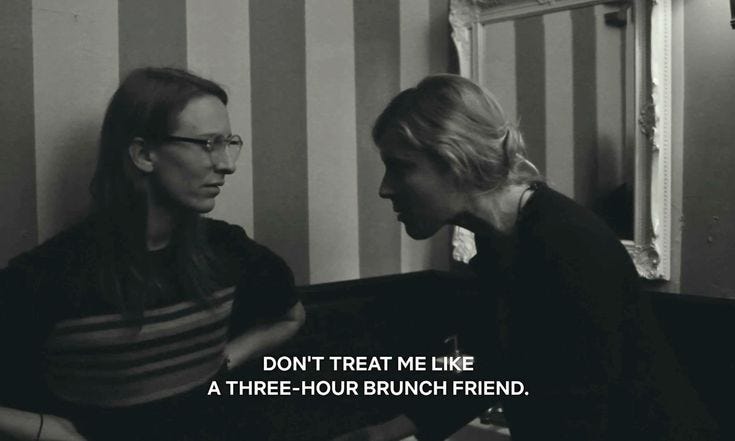
A loss of reciprocity
My friends are currently single. And it’s not that they aren’t open to talking about their dating experiences, but it no longer feels reciprocal. My friend explains that her friends are so well-intentioned. They’re curious about her dating life, asking to swipe on her apps and dropping the occasional “sex life” question.
And she doesn’t mind sharing, but it’s not met with reciprocal vulnerability. When she asks about their relationships, they quip, “They’re fine! Everything is fine.” There’s no exchange, so there’s no intimacy. One-way sharing isn’t conducive to cultivating closeness. If anything, it can feel isolating on both ends.
It widens what seems like an ever-growing divide between those who are partnered vs. single. Divvying us up into categories of who we can still feel close to, and who’s partnered just out of reach. It creates a gap we can’t close, unless we’re willing to be vulnerable regardless of relationship status. Disconnection breeds disconnection.
The caveat
To caveat, I’m not suggesting that the path back to connection is to talk shit about our relationships. Or that you have to disclose the intimate details of your paternship to your friends.
But I guess I’m wondering, what stops you from reaching out for the same type of support that buoyed you through your twenties? What is it about partnership that makes us want to lock the door and toss the keys? And who, in the long run, does that really support? When we stop outsourcing support, do both our friendships and partnerships suffer?
In some cases, privacy is necessary. It’s also a boundary, personal to each relationship dynamic. There are conversations to be had about what is OK to share without rupturing trust. And there’s the question of who we feel comfortable sharing with — the assumption is that we want to share with friends who can meet us with compassion and curiosity, who approach the conversation with a desire to understand and support. And ideally, never to judge.
But hypothetically, if all of these conditions are met, we have so much more to gain than to lose.
I scoop some ice cream from the almost-empty carton and plop back onto the floor, across from two people who know almost all the versions of me.
And sitting there, I pull up the gate and throw the windows open. I tell them about the things in my relationship that have been hard, the things that have been good, and the things that fall somewhere in between. I talk about timing and transitions. They listen, but they also reflect back what I need to hear. They offer fresh perspectives and push back where it’s needed, because they know me.
And I don’t just tell them because I want our relationship to feel reciprocal (I do), or because I want them to feel safe sharing their experiences with me (I do), but because our relationships are about feeling seen. And we’ll never feel seen if we hide.
I don’t know exactly what it looks like, but I know I want to preserve some version of the closeness we once had. The kind that doesn’t make you question the connection. The kind that survives distance and time apart because you can cut straight to the core of it all.
I think I’ll stain my friendships with vulnerability and call it beautiful.
why do your substacks always leave me teary ! this is such an interesting nuance re sharing in relationships ive felt but never really thought about before !!